
Downspouts Routed Right the First Time
Gutter installation in Choctaw for new construction, replacement systems, and properties without adequate water routing
A gutter system that cannot handle the volume coming off a steep-pitch roof during a hard storm will overflow at the seams before the rain stops, and that overflow lands at the foundation perimeter—exactly where it causes the most long-term damage. Gray Feather Roofing installs gutters and downspouts on residential and commercial properties in Choctaw, sizing each run for the roof area it serves and routing discharge away from the structure at grade. Properties without gutters, or with undersized systems left over from a previous installation, are both common starting points for this work.
Installation begins with a site assessment that accounts for roof pitch, eave length, and where water needs to discharge—whether that is to grade, a splash block, or an existing storm drain connection. Custom-cut aluminum gutter sections are sized at 5-inch or 6-inch width depending on the drainage load, and brackets are set every two to three feet along the run rather than spaced wider, which prevents the sag that develops when a gutter holds standing water between storms. Pitch is verified across the full run before downspouts are attached, because a level-looking gutter that is not pitched toward the outlet will pool and eventually separate at the seams.
Request a property assessment from Gray Feather Roofing to determine the correct gutter sizing and downspout placement for your roof configuration.
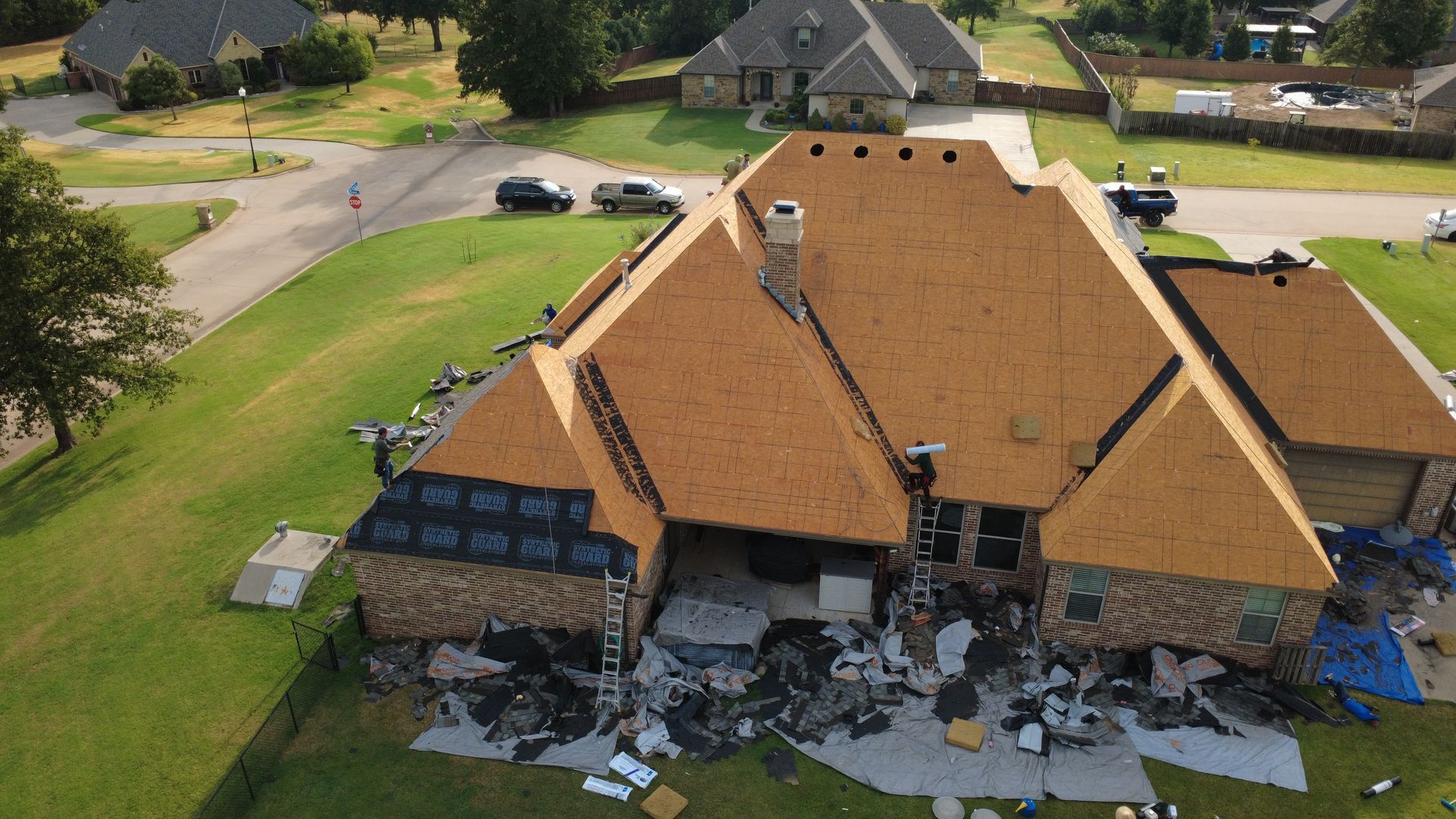
What Proper Gutter Installation Requires
The difference between a gutter system that lasts and one that requires repair within two or three years often comes down to decisions made during installation that are not visible once the job is complete. Bracket spacing is one of those decisions—wider spacing looks the same from the ground but allows the gutter to flex under load, which shears the sealant at end caps and outlet holes over time. Downspout placement is another: a single downspout serving more than forty linear feet of gutter in a high-volume roof area will back up during peak flow regardless of how well the rest of the system was installed.
After installation, the completed system carries water from the roofline to discharge points without overflowing at joints, pooling at low spots, or pulling away from the fascia under the weight of a full gutter. The fascia board stays dry because the back edge of the gutter is positioned to collect drip-edge runoff rather than letting it track behind the hanger. Gray Feather Roofing sets pitch across the run so that standing water drains fully between rain events rather than sitting in the channel and accelerating joint failure.
Seamless aluminum remains the standard for most residential installations because it eliminates the seam-to-seam joints where sectional systems most commonly develop leaks; sectional systems are a workable alternative for shorter runs or budget-constrained projects where the joint locations can be kept to a minimum. Color matching to existing fascia trim is available in standard aluminum stock colors and does not require painting, since the finish is applied to the coil stock before the gutter is formed.
What Property Owners Ask About Gutter Installation
These questions come up regularly during installation projects in Choctaw, particularly when replacing an older system or adding gutters to a home that did not originally have them.
What determines whether a property needs 5-inch or 6-inch gutters?
Roof area and pitch both factor into the calculation—a steeply pitched roof concentrates runoff more rapidly than a shallow one, so a smaller roof area with high pitch can require larger gutters than a larger flat-roof area; 6-inch gutters are typically recommended when a single run handles more than 1,000 square feet of drainage area.
How is the bracket spacing decided during installation?
Brackets are placed every two to three feet as a standard interval, but that spacing tightens at corners, outlet holes, and any location where the fascia board shows soft spots or previous damage, since those areas carry concentrated load when the gutter is full.
Why does downspout placement matter beyond just getting water off the roof?
Downspouts must discharge at a point where the grade slopes away from the foundation; a downspout that terminates flat or toward the structure sends water directly to the footing, which is the same problem an absent gutter creates—just concentrated at one location instead of distributed along the eave.
How do Choctaw's residential construction patterns affect gutter sizing decisions?
Many single-family homes in the area were built with standard 5-inch gutters during an era when those were the default, but additions, re-roofing with steeper pitches, or extended overhangs can push drainage volume beyond what the original sizing handles.
What should you verify once gutter installation is finished?
Run water through the system with a hose and check that the flow exits at the downspout without backing up at any joint, that no water tracks behind the back edge of the gutter onto the fascia, and that the discharge clears the foundation edge by at least four feet.
Gray Feather Roofing also installs gutters in Midwest City, Del City, and Harrah. Arrange a roof and eave assessment with Gray Feather Roofing to confirm the correct gutter profile, bracket plan, and downspout routing for your property before installation begins.