Rubber Roofing That Holds Through Temperature Swings
EPDM roofing in Choctaw for industrial and warehouse flat roofs with puncture damage, membrane shrinkage, or split seam conditions
Oklahoma's temperature range—from hard winter freezes to triple-digit summer heat—puts flat roof membranes through repeated expansion and contraction cycles that rigid or less flexible materials handle poorly. EPDM rubber roofing's molecular structure allows it to flex through those cycles without cracking, which is why it became the standard membrane on industrial and warehouse flat roofs across this region. Gray Feather Roofing installs and repairs EPDM systems for commercial buildings throughout the Oklahoma City area, working on everything from new membrane installations on bare decks to repair scopes on shrinking or split systems that have reached the point where patches alone will not hold the assembly together.
EPDM is a single-ply rubber membrane installed in large sheets to minimize the number of seams on the finished roof—fewer seams mean fewer potential infiltration points, which is a meaningful advantage on low-slope roofs where water sits rather than runs. Seams between sheets are sealed with contact cement or seam tape, and edges are mechanically fastened to the deck perimeter and at termination bars along parapets and flashings. Inspection for EPDM systems focuses on three specific failure modes: punctures from traffic or hail impact, seam separation at contact-cement-bonded laps, and membrane shrinkage that pulls flashings away from walls and parapets. Shrinkage in particular is a common condition on older EPDM installations in this climate, where decades of UV exposure cause the rubber to contract and pull edge terminations loose.
Schedule a membrane inspection with Gray Feather Roofing to identify current seam and flashing conditions before the next Oklahoma storm season begins.
The Difference Between EPDM Repair and Full Replacement
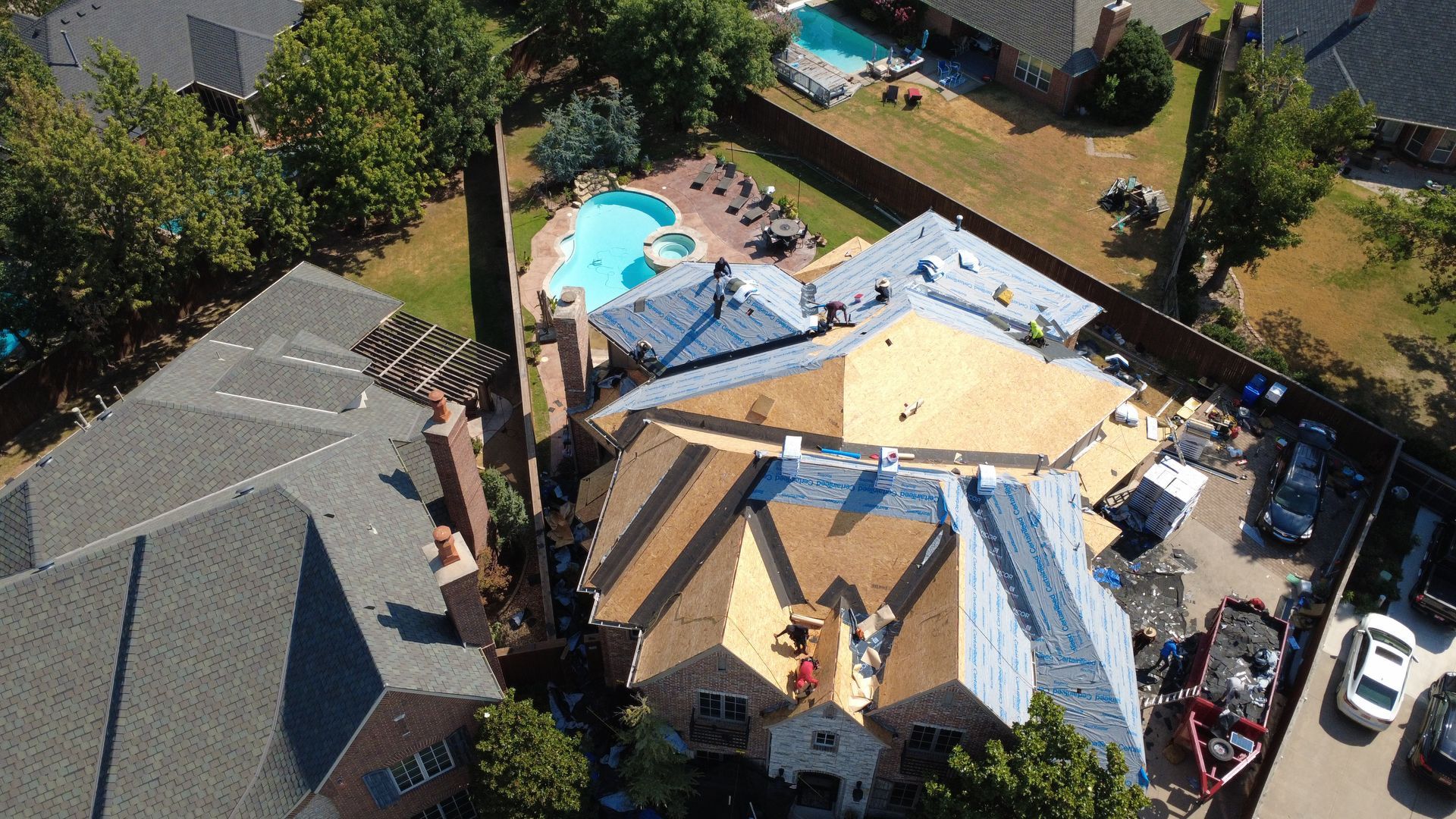
EPDM repair and replacement involve different scopes and different cost structures, and the decision between them is driven by how much of the existing membrane is compromised. Isolated punctures are patched using EPDM patch material bonded with contact cement, followed by seam tape over the patch perimeter. Seam separations are re-adhered or covered with cover tape if the original substrate is still clean and the membrane has not shrunk away from the seam line. When shrinkage has pulled the membrane significantly, re-bonding the original seam is not a reliable repair—the tension in the shrunk membrane will re-open the lap over the following season. Full replacement removes the existing membrane and, where insulation has been saturated, the wet insulation board as well, since reinstalling a new membrane over wet insulation creates the same moisture-trap problem as the original failure.
After a completed EPDM installation, the roof presents as a uniform dark gray or black field with smooth, flat seam lines and fully adhered flashing terminations at all parapets, penetrations, and drains. Walls and curbs that previously showed gap conditions where the membrane had pulled away will have new flashing laps properly bonded and terminated. EPDM's twenty-five-to-thirty-year service life is achievable on Oklahoma commercial buildings when the system drains correctly and the membrane is inspected after significant hail events, which can create impact damage not visible from ground level.
EPDM's cost-effectiveness compared to TPO and modified bitumen comes partly from material cost and partly from installation labor—large-format sheets cover more area per seam than multi-layer systems, which reduces seaming time. However, replacement labor is more intensive than TPO replacement because the contact-cement-bonded membrane adheres to the insulation and requires mechanical removal rather than simple membrane peel. That labor factor is worth understanding when comparing per-square-foot estimates across membrane types, because the base material cost does not reflect the full labor picture on a tear-off-and-replace scope.
Common Questions About EPDM Rubber Roofing
EPDM generates specific questions about how rubber membrane behaves differently from other flat roofing materials, particularly around durability, repairability, and performance in this region's climate. The following addresses those questions directly.
What causes EPDM membrane shrinkage, and how is it identified?
UV exposure over time causes the rubber compound to contract, which shows up as flashing corners pulling away from walls, membrane edges lifting at termination bars, and visible tension lines across the field—once shrinkage is apparent, the affected terminations need to be re-flashed with new membrane material rather than simply re-adhered.
How does EPDM handle Oklahoma hail compared to modified bitumen?
EPDM's rubber flexibility allows it to absorb impact without the surface cracking that can occur on harder bituminous membranes, but significant hail concentrated in a small area can still puncture single-ply EPDM—post-storm inspection is the only reliable way to identify impact damage on Choctaw-area industrial roofs after a severe weather event.
Why are EPDM seams bonded with contact cement rather than heat-welded like TPO?
EPDM's thermoset rubber chemistry means it cannot be heat-fused the way thermoplastic TPO can—the bond is achieved chemically through contact cement or seam tape, which requires proper surface preparation and dry conditions at installation to achieve full bond strength.
When does a punctured EPDM roof need replacement rather than patching?
When punctures are isolated and the surrounding membrane is pliable and fully adhered, patching is appropriate—when the membrane has become brittle, multiple punctures exist across the field, or shrinkage has compromised more than thirty percent of the edge terminations, full replacement is the more reliable path.
What is the maintenance schedule for an EPDM roof in this climate?
Semi-annual inspection—once before summer heat and once before winter—to check seam integrity, clear drains, and probe flashing laps for adhesion loss is the standard cycle that catches the most common EPDM failure conditions before they advance to structural water damage.
Gray Feather Roofing carries the technical knowledge to assess whether your existing EPDM system needs targeted repair or a full membrane replacement based on what the inspection actually reveals. Call (405) 294-7639 to arrange a detailed rubber roof evaluation for your commercial property.