When Storm Damage Stops Business Operations Cold
Commercial storm restoration in Choctaw for facilities with active roof damage, interior moisture intrusion, or insurance claim requirements
Gray Feather Roofing provides emergency commercial storm restoration for business properties in Choctaw, working through the full sequence from initial damage control to final repair and insurance coordination. Commercial roofs—whether low-slope membrane systems on retail strips or metal-panel assemblies on warehouse facilities—sustain damage patterns that differ significantly from residential work: membrane punctures, flashing separations, and compressed insulation layers that don't show as obvious surface failures but allow moisture to migrate into the roof assembly for weeks before interior signs appear. Business owners dealing with pooling water, ceiling staining, or visible surface damage after a hail or wind event need a contractor who understands both the physical damage and what an insurance adjuster requires to approve a claim.
The work begins with emergency tarping to stop active infiltration, followed by a structured damage assessment that includes photo documentation of impact patterns, membrane condition, and flashing integrity. Gray Feather coordinates directly with facility management to sequence repairs around operational schedules, and holds manufacturer certifications from GAF and Owens Corning—credentials that are specifically required by many carriers before a claim-based replacement will be approved. Attic and deck inspection is included to identify internal moisture damage that surface-only assessments routinely miss.
Schedule a property-specific damage assessment to document current roof conditions and begin the insurance coordination process.
How Storm Restoration Addresses Commercial Roof Damage
Commercial roof systems fail differently than residential shingles after a hail or wind event. A single-ply membrane may show hundreds of small impact craters that compress the insulation below without visibly tearing the surface; mechanically attached systems can experience fastener pull-through that isn't apparent until uplift occurs in the next wind event. The documentation phase of storm restoration captures these failure patterns in a format that maps to adjuster line items—impact density per square, flashing displacement measurements, and deck condition assessments that support the claim rather than leaving gaps an adjuster can use to reduce scope.
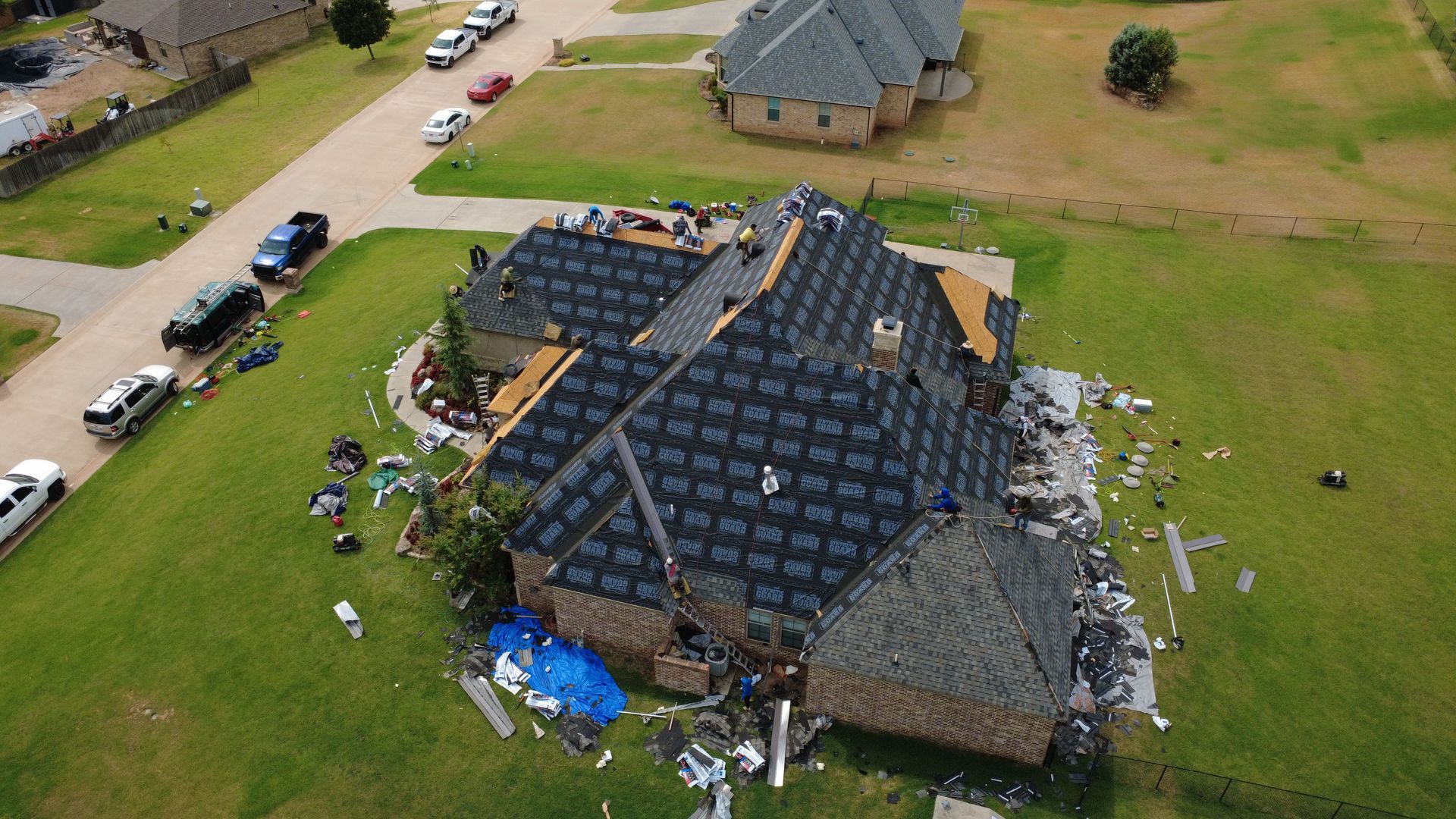
Once adjuster estimates are finalized, Gray Feather executes repairs or full replacement to match the approved scope, using materials that satisfy the certification requirements attached to the claim. Business owners typically notice the difference in two ways: standing water that was accumulating in low spots drains correctly once membrane integrity is restored, and interior humidity in spaces below the roof deck normalizes within days as the infiltration pathway is closed.
Repairs are scheduled and sequenced to minimize operational disruption—crews work in defined sections and coordinate access with facility staff rather than shutting down loading areas or customer entrances for extended periods. The work includes post-installation inspection to confirm seam integrity and flashing terminations before the job is closed.
Answers About How Commercial Storm Restoration Works
Commercial property owners and facility managers often have detailed questions about storm restoration procedures before committing to a contractor, particularly when insurance claims are involved. The following covers the most common process and documentation questions specific to commercial storm work.
What happens during the initial storm damage assessment?
The assessment documents impact patterns, membrane condition, flashing displacement, and deck integrity using systematic photography and measurements organized by roof section—this structure is designed to match the line-item format insurance adjusters use when reviewing commercial claims.
How does manufacturer certification affect the insurance claim process?
Many carriers require that replacement materials be installed by a certified contractor for the claim to be processed at full replacement value; Gray Feather holds GAF and Owens Corning certifications that satisfy this requirement and should be confirmed before work begins on any claim-funded project.
Why does attic inspection matter after a storm event?
Moisture that enters through a compromised membrane or flashing can travel laterally inside the roof assembly before becoming visible inside the building; an attic inspection identifies wet insulation, stained decking, or mold initiation that a surface-only assessment would miss and that would need to be included in the claim scope.
What does storm restoration include beyond the visible surface repair?
Work includes tarping, damage documentation, coordination with the adjuster's scope, membrane or shingle repair or replacement, flashing integration, and a post-installation inspection confirming seam and termination integrity before the job closes.
How is repair sequencing managed for occupied commercial buildings in Choctaw?
Crews divide the roof into sections and coordinate access points with facility management so that loading docks, customer entries, and operational areas remain functional during the work rather than being blocked for the full project duration.
Gray Feather Roofing handles commercial storm restoration from emergency stabilization through final inspection, with documentation formatted to support the insurance process at each stage. Arrange a structured damage assessment to establish current roof conditions and identify what the claim scope should include. Gray Feather Roofing also provides commercial storm restoration in Oklahoma City and surrounding communities.